Airbnb Management and Listing Optimization in Cape Town
Cape Town is one of the most competitive short-term rental markets in Africa. There are more listings than there are guests in June, and more guests than good listings in January. Winning here is less about the property than about how the listing is built and priced for a market that swings this hard.
HostBooked is Superhost-led. We work on Cape Town listings the same way every week — rebuilding titles, reordering photos, resetting price floors — and this page covers what that actually involves locally.
What Cape Town hosts are up against
The seasonality is extreme
Few markets swing as hard as this one. December and January are near-saturated, with visitors from Johannesburg, Europe and North America competing for the same stock. June and July are the opposite problem — a large share of listings sit empty for weeks.
The mistake most hosts make is running one pricing strategy across both. A rate that's sensible in peak leaves you invisible in winter, and a winter floor left in place through December gives away thousands. This is the two-lever problem: your headline rate and your price floor need to move independently and on different schedules. The full method is in the two-lever pricing strategy that fills shoulder season.
Supply density on the Atlantic Seaboard
In Sea Point, Green Point and Camps Bay, a guest's search results are full of apartments that are genuinely similar — same building era, same finishes, same view of the same ocean. Differentiation cannot come from the property alone, because the property next door is comparable.
It has to come from the listing: which photo leads, what the first 32 characters of your title say, and whether your description answers the specific question a guest in that area is actually asking. Load-shedding backup, secure parking, and walkability all sell harder here than another photo of the bedroom.
Guests here research heavily
The international share of Cape Town's guest mix means longer booking lead times and more comparison shopping. These guests read reviews properly, check response rates, and notice inconsistencies between photos and descriptions. Sloppy listings are punished more here than in markets driven by last-minute domestic bookings.
How we optimize a Cape Town listing
The work is the same four levers in every market; what changes is the local judgement applied to each.
- Photo sequence. In a view-driven market, leading with an interior shot is usually a mistake. If you have Table Mountain, the Atlantic, or a pool, that's the frame that earns the click. Detail in your first photo decides everything.
- Title and positioning. Front-loaded with the differentiator that matters to a guest choosing between six similar apartments, not a generic description of the property type.
- Pricing structure. A seasonal base, event overrides for the dates the city predictably spikes, hard peak minimums, and a floor low enough to catch winter demand without giving away summer.
- Messaging and review flow. Automated so response rate holds, warm enough that guests actually leave reviews. See the message flow we use.
Underneath all four sits conversion rate — the strongest signal Airbnb has, and the reason photo and title work outperforms everything else. Full breakdown in what the Airbnb algorithm actually rewards in 2026.
Pricing for the Cape Town calendar
Peak (mid-December to end January). Protect these dates with hard minimums so dynamic tools can't undercut them. Set minimum-stay requirements. This is when your annual margin is made.
Shoulder (February to April, October to November). The most winnable months, because most hosts price them lazily. Good weather, lower competition, and guests who are genuinely comparing.
Low (May to August). Drop the floor, not the headline rate. A booked winter night at a modest rate earns income, generates a review, and signals demand that lifts your ranking for the peak dates ahead. An empty night does none of those things.
Events. Cape Town has a predictable calendar of events that spike demand. Override your dynamic pricing on those dates rather than trusting the tool to notice.
Areas we work in
We work with hosts across:
- Atlantic Seaboard — Sea Point, Green Point, Mouille Point, Bantry Bay, Camps Bay, Clifton
- City Bowl — De Waterkant, Gardens, Tamboerskloof, Oranjezicht, CBD
- Southern Suburbs — Observatory, Woodstock, Newlands, Claremont
- False Bay and the South Peninsula — Muizenberg, Kalk Bay, Fish Hoek, Simon's Town
- Northern Suburbs and Winelands — remotely, including Stellenbosch and Somerset West
All of the work is done remotely — you don't need us on site to rebuild a listing.
What you get
Three ways to work with us, all fixed-fee rather than a percentage of your revenue:
- Tune-Up — $349 per listing. A full 40-point audit, rewritten title and description, photo order and caption plan, pricing recommendations, and 7 days of implementation support.
- Optimize — $899 per listing. Everything in Tune-Up, implemented for you, plus dynamic pricing set up and tuned, an automated guest message flow, a digital guidebook, a 45-minute strategy call and a 30-day review.
- Autopilot — $249/month plus 8% of booking revenue. We run the listing remotely: pricing and calendar, 24/7 guest communication, review recovery, cleaner coordination and monthly reporting.
Local bank transfer in rand is available as an alternative to card payment. Full detail on the pricing section, and the initial audit is free either way.
Before and after: a Table View guesthouse
The work below is from a multi-room guesthouse in Table View, minutes from Blouberg Beach, where we rebuilt the listings room by room. We’ve split the examples into two categories, because they involved different work and it matters which is which.
Restaging and reshoot
These rooms were physically restaged before reshooting — lighting added, soft furnishings and wall art introduced, surfaces dressed. The room itself changed, not just the photograph.
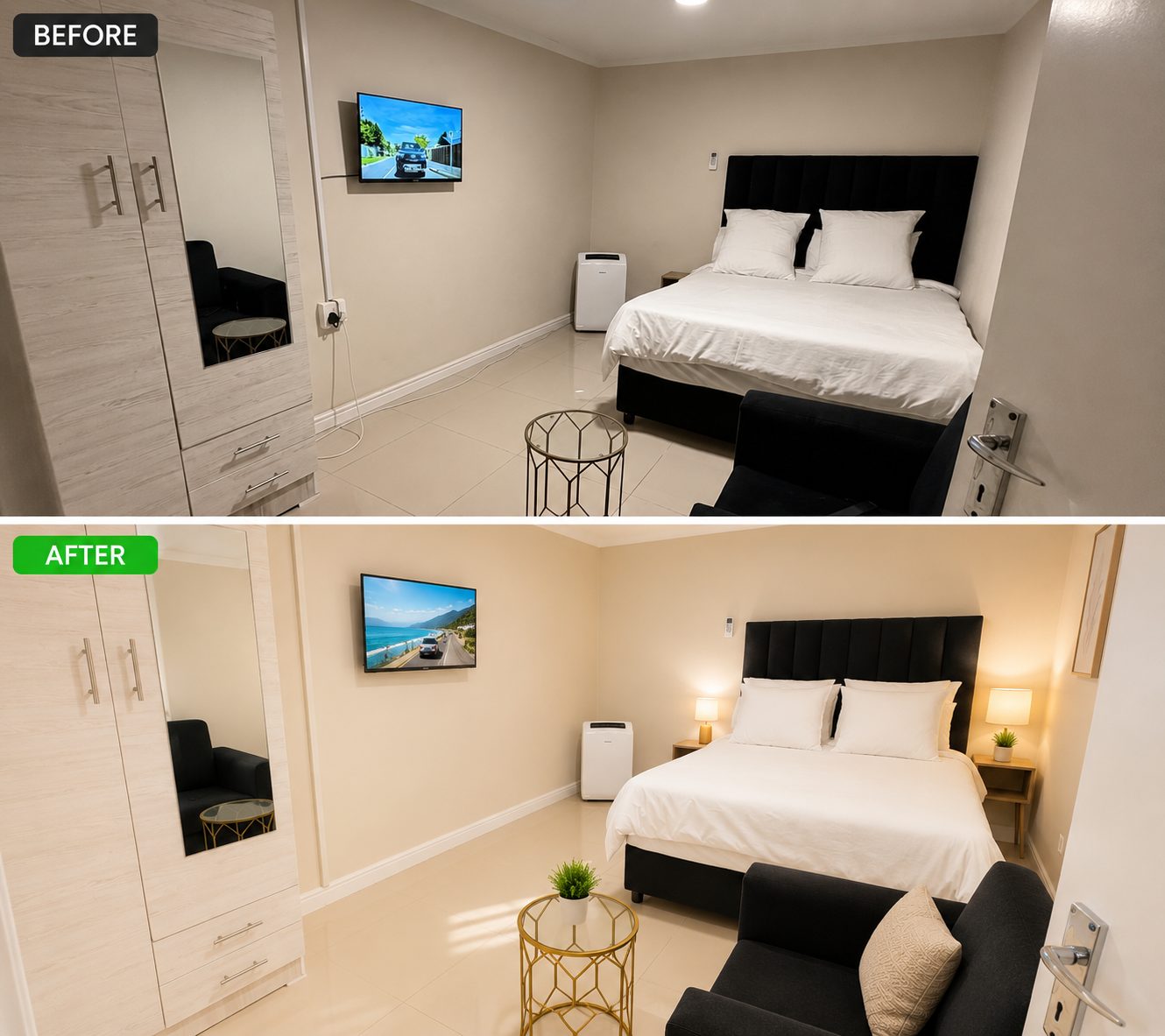
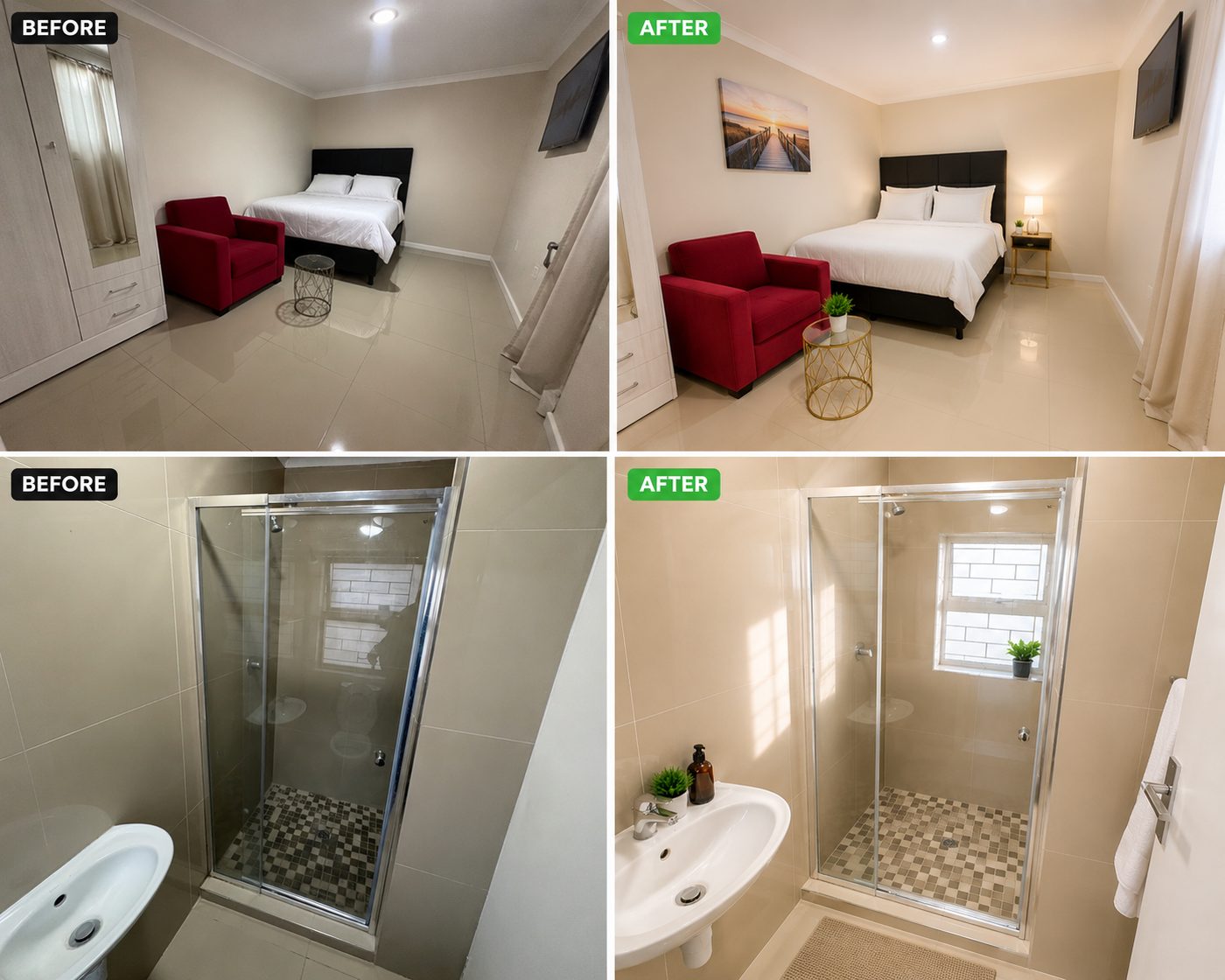
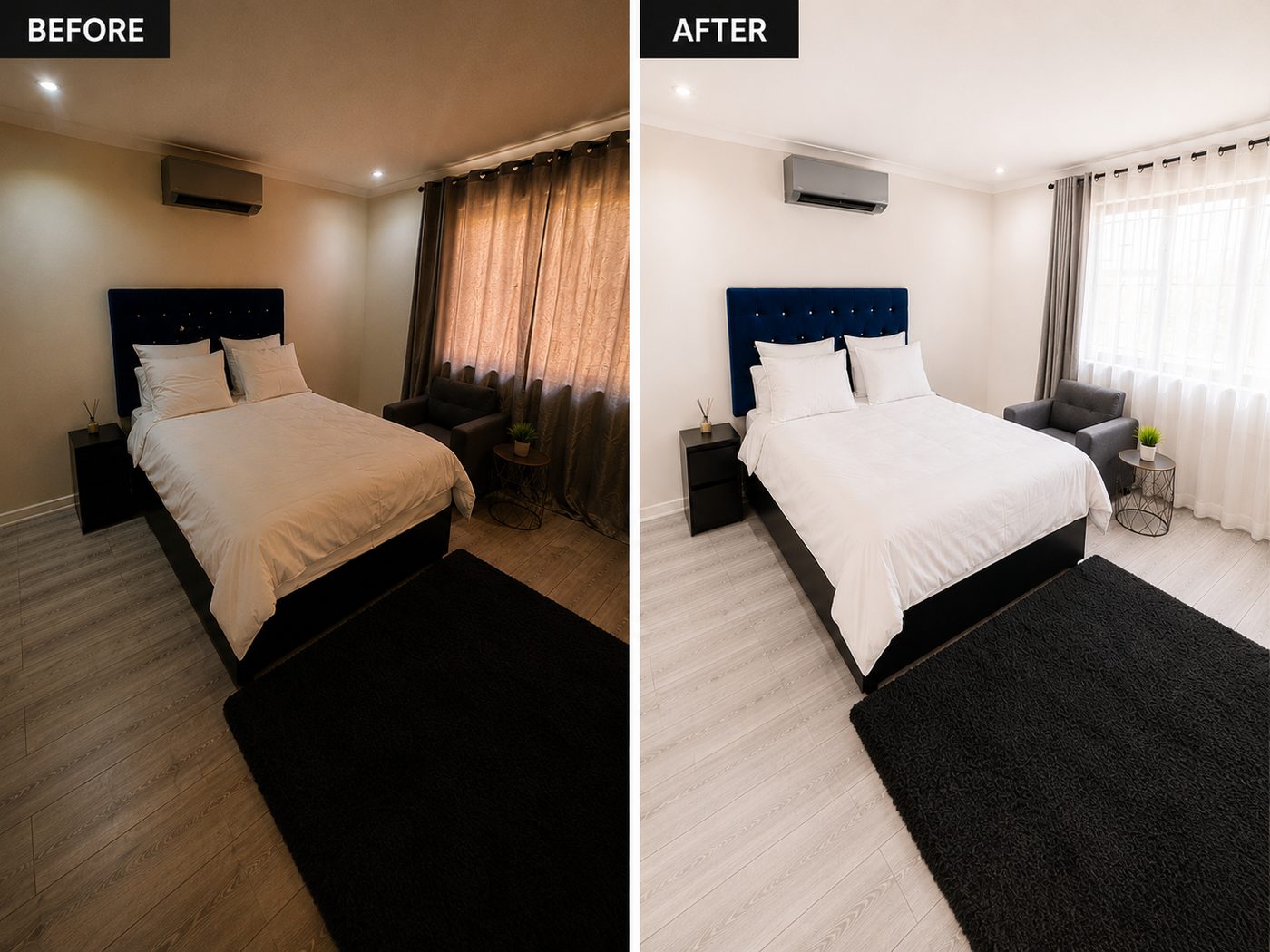
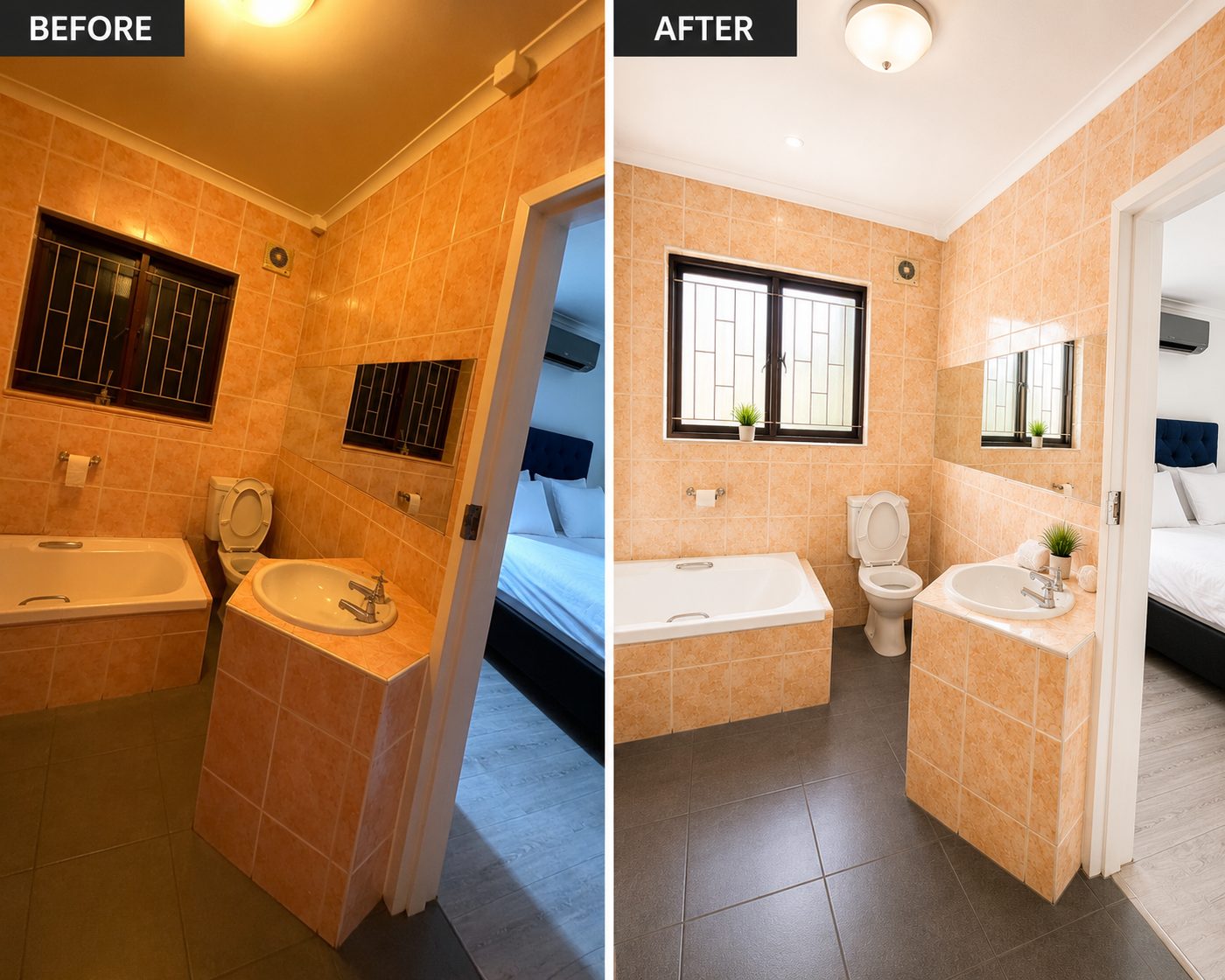
Photo optimisation — same room, corrected images
These are the same rooms, unchanged, re-edited. Exposure, white balance and shadow recovery only. No furniture moved and nothing added.
We’re labelling these separately on purpose. Correcting a tungsten colour cast is a real and worthwhile service — underexposure and yellow-orange interiors are the most common technical faults we see on Cape Town listings — but it is photo work, not a property transformation, and it would be misleading to present it as one.
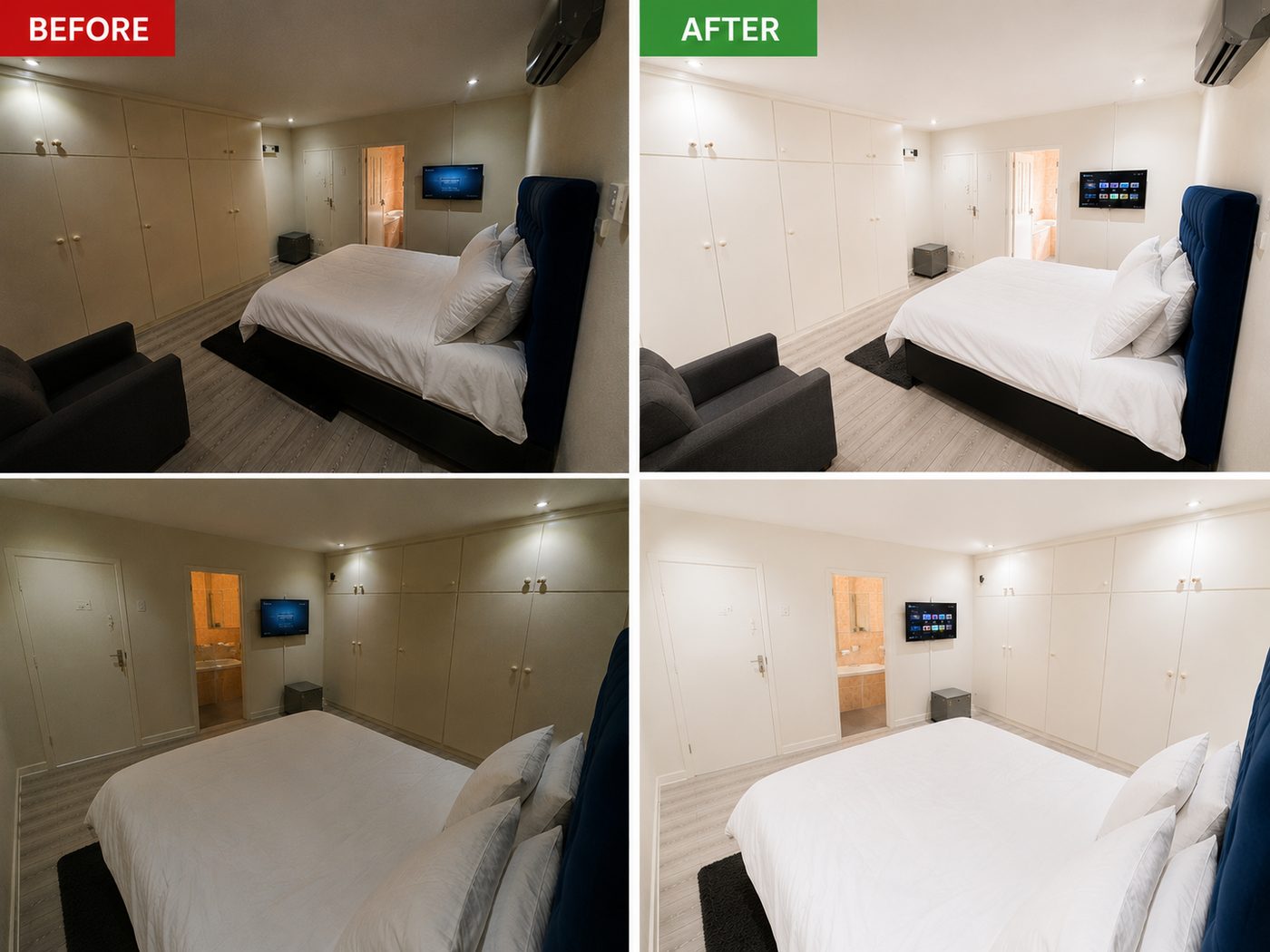
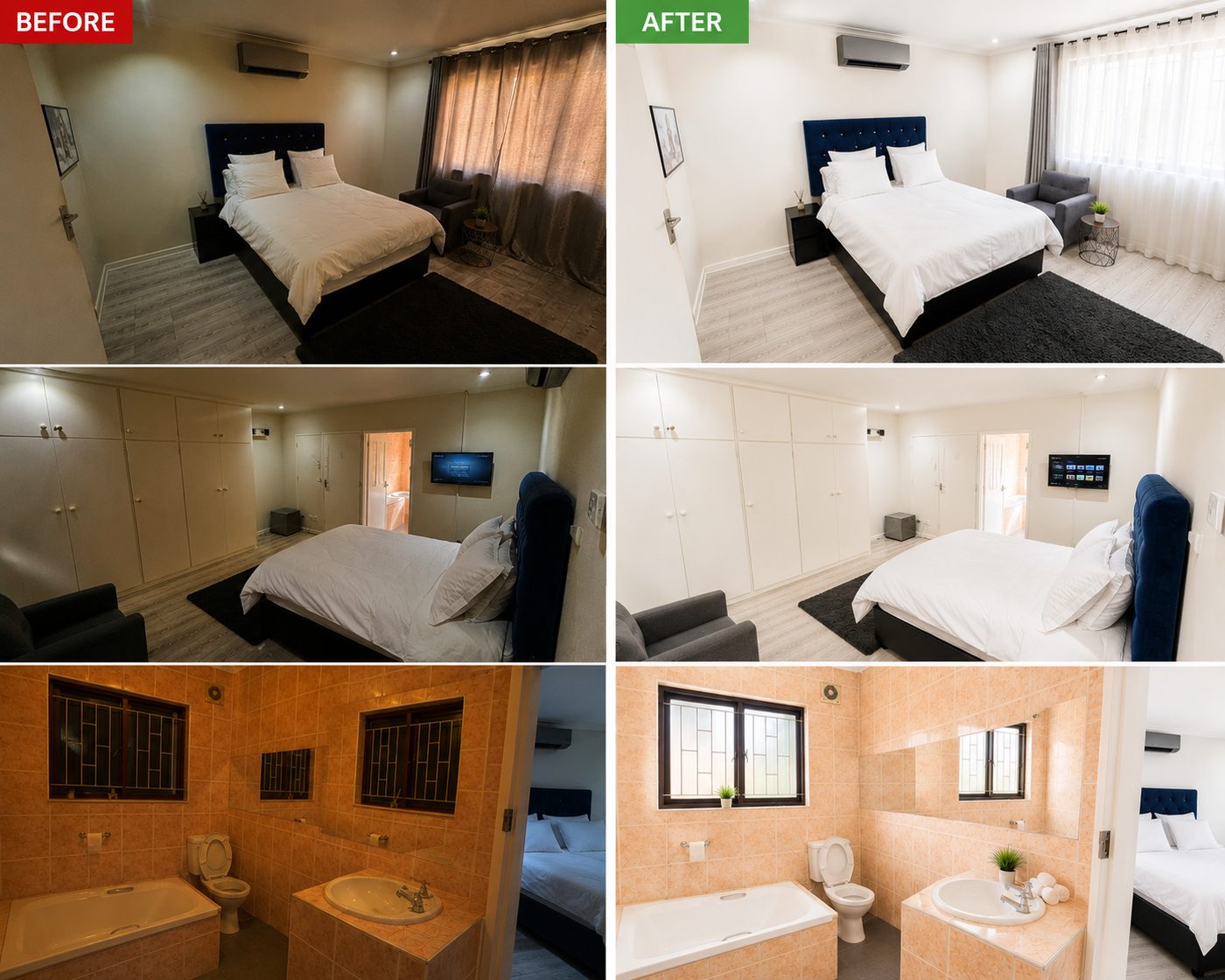
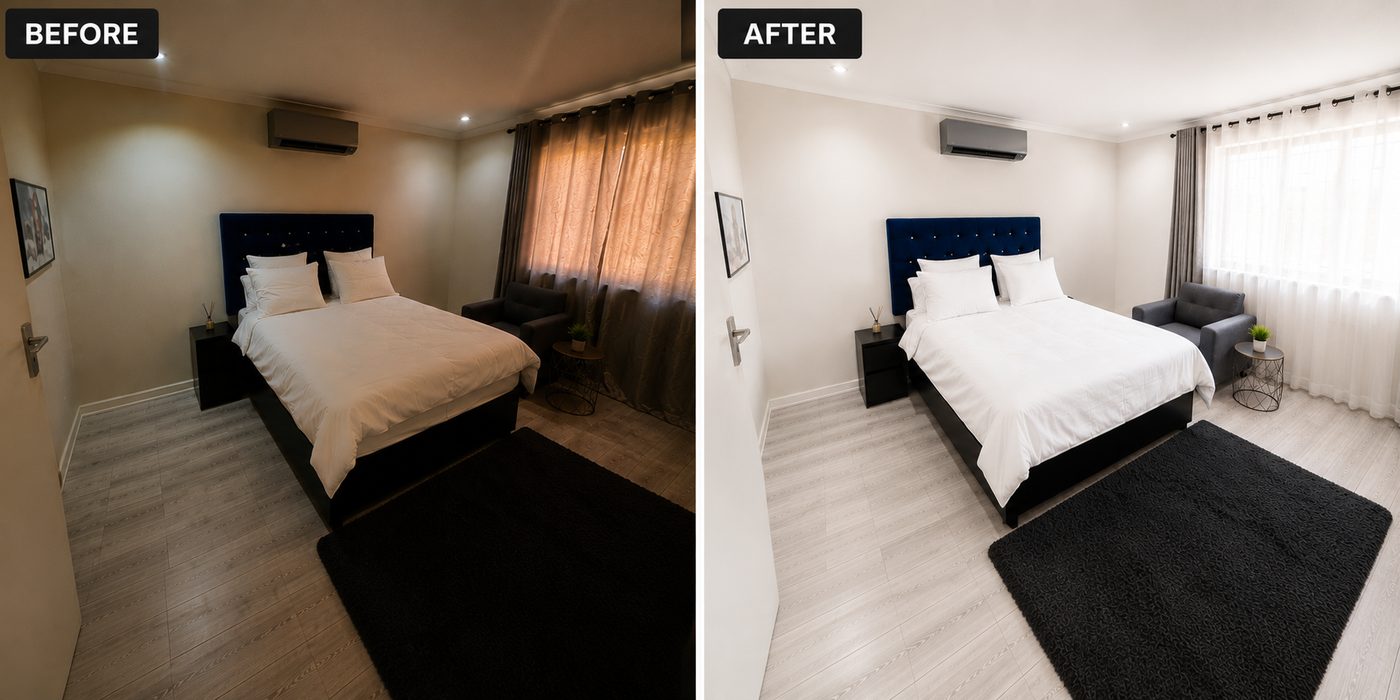
Why photo work moves bookings
Photos sit at the top of the conversion funnel, and conversion is the strongest ranking signal Airbnb has. A corrected lead image lifts click-through, which lifts conversion, which lifts ranking, which brings more of the traffic your improved photos now convert. It compounds, and it costs less than any other intervention available. The method is in your first photo decides everything and what the Airbnb algorithm actually rewards in 2026.
The documented result
This is a private guesthouse room near Blouberg Beach with a pool, home-cooked meals on request, and a famous coastline on its doorstep — and a listing that mentioned almost none of it.
- Before: 12 photos, only three doing real work. A one-line description, and a title that set the wrong expectation.
- What we changed: Lead photo and title rebuilt around the pool and the beach. Full description written. Gallery curated and resequenced.
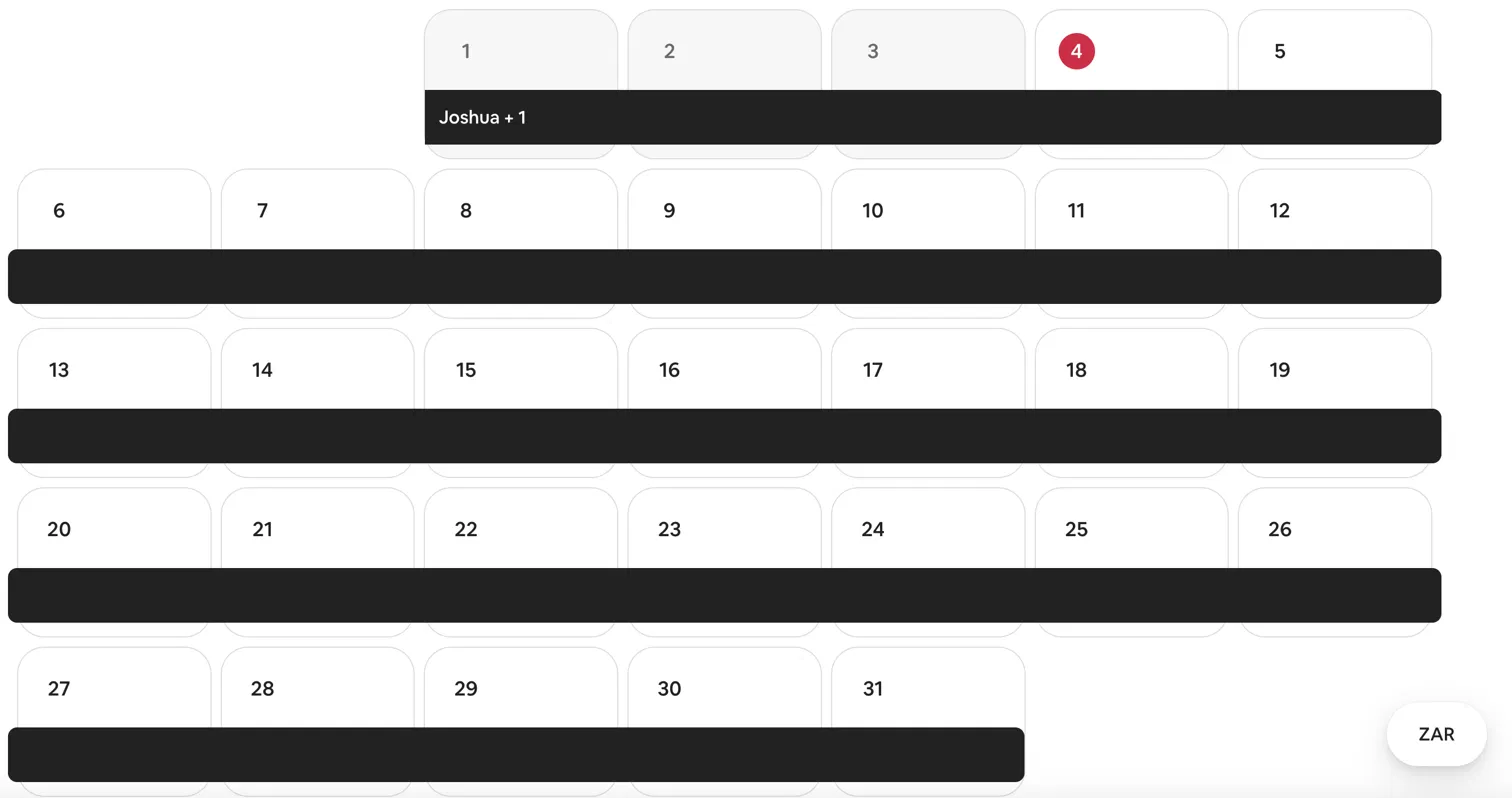
- Result: July booked solid — a single 31-night stay, 100% occupancy, one turnover, zero gap nights.
“HostBooked completely reframed our Blouberg room. They led with the pool and the beach, rewrote the title and description, and showed us exactly which photos to keep and which to cut. The listing finally reflects what guests actually get.”
— Isaac, Joy House Stay, Table View, Cape Town
Common questions
How much does Airbnb management cost in Cape Town?
We work on fixed-fee optimization packages rather than a percentage of revenue, so the cost doesn't scale with your success. Current pricing is on our pricing section, and the initial audit is free.
Do you take over the listing completely?
Only if you want that. Most hosts start with a one-off optimization and keep day-to-day control. If you'd rather self-manage afterwards, run your listing in one hour a week covers the systems to put in place.
How long before I see results?
Listing changes take effect immediately, but Airbnb needs several weeks of booking data before re-ranking. Most hosts see measurable movement within four to eight weeks. Anyone promising faster is guessing.
Do you work with Booking.com and Vrbo listings too?
Yes. We work with hosts on Airbnb, Vrbo and Booking.com. The underlying work — photography, positioning, pricing structure — carries across all three.
Hosting elsewhere?
We also work extensively with shortlet owners in Nigeria — see shortlet and Airbnb optimization in Abuja.
Get a free listing audit
We'll send you the three highest-impact changes for your listing — no cost, no obligation.
Get my free audit → Book a call